
Understanding Leadership: The Leadership Venn Model Explained
Discover the Leadership Venn Model, a practical framework that clarifies how effective leadership emerges from the alignment of competence, motivation, and power. Learn why leadership is more than just a title or experience.
Jef Lercher Verstraeten
4/8/202614 min read
You’re moving through complex terrain. The group is progressing smoothly—clear structure, a guide in front, decisions being made almost effortlessly. Then something happens. The guide slips. An accident—not catastrophic, but enough to disrupt the flow, enough to remove certainty. For a brief moment, everything pauses. The structure is still there, but the leadership is not. No one has officially taken over, yet the need for direction has not disappeared. Then, almost quietly, someone in the group steps forward. They check on the guide, begin to assess the situation, ask the right questions, suggest the next move. The group starts to orient around them. Nothing has formally changed—no title reassigned, no role redefined—and yet, unmistakably, something has shifted. Leadership has emerged, not because it was assigned, because it was needed.
Leadership was present—but not where the structure said it should be.
The common misunderstanding of leadership
We often reduce leadership to something tangible and easy to assign: a title on an organisational chart, a strong personality in the room, or years of experience in the field. It gives a sense of control—if we can name the leader, we assume leadership is taken care of. But in practice, these proxies regularly fail us. A title does not guarantee that someone will act when it matters. Competence does not ensure that someone will step forward. And confidence, perhaps most misleading of all, does not guarantee sound judgment.
What we label as leadership is often just the mere opportunity for leadership. The actual phenomenon is far more fragile and situational. It depends not on what someone is called, but on what happens in a specific moment, within a specific group, under specific conditions.
Leadership is not a trait or a position. It is a condition that emerges when specific elements align.
The Leadership Venn
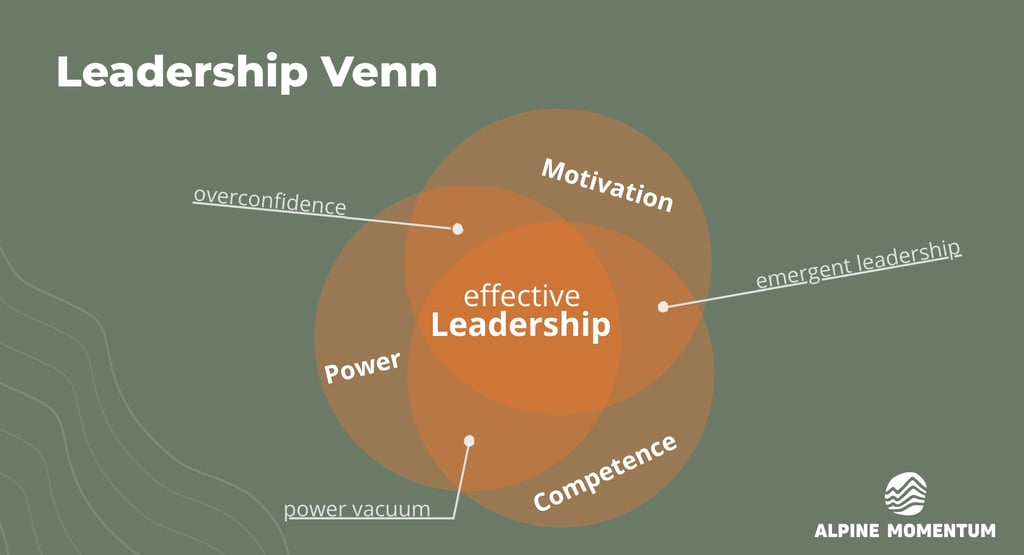
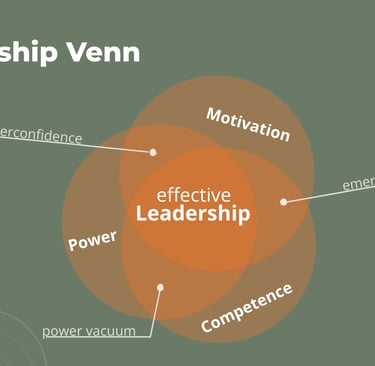
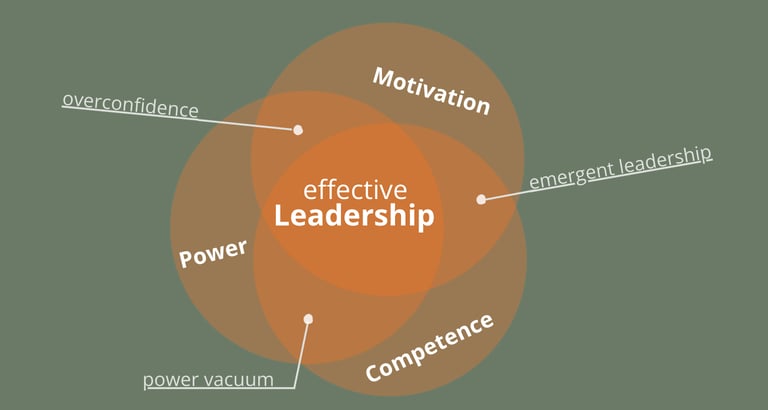
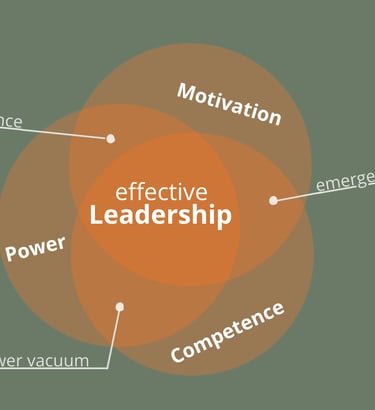
At the core of this model lies a simple but powerful idea: leadership is not a fixed attribute, but something that emerges when three independent conditions align.
Leadership arises at the intersection of:
Power – the legitimacy to lead
Competence – the ability to lead
Motivation – the willingness to lead
Only when all three overlap does effective leadership emerge—clear in direction, grounded in competence, and accepted by the group.
Competence – the ability to lead
Competence in leadership goes far beyond technical expertise. It is useful to distinguish between hard skills and soft skills here. Hard skills include technical knowledge, movement, planning, and task execution—what to do. These are visible, measurable, and often the basis on which people are selected into roles.
But true leadership lives primarily in the realm of soft skills—how things are done with and through others. This includes decision-making under pressure, situational awareness, communication that is both clear and constructive, emotional intelligence, and the ability to read a group. It also requires the flexibility to adapt one’s leadership style to the moment: creating space and inviting others to step forward when appropriate, fostering ownership and psychological safety, and, when needed, becoming more directive to provide clarity and structure.
In the mountains hard skills are often even easier to recognise then in business. They reveal themselves in movement, timing, and the subtle technical choices that shape the route. Soft skills, however, are initially less visible—but far more decisive. They determine whether a group trusts the leader and his decisions, whether people dare to speak up, and whether guest choose to rebook because of a positive experience.
A person can possess outstanding technical competence and still not lead. Leadership is not about outperforming others technically, but about a connecting people behind a shared goal, aligning people towards cooperating towards it, and initiating action adapted to each’s abilities. It requires stepping into the relational space of the team—something that demands awareness, intent and especially energy.
The fact that it requires energy is precisely the cause why the burden is often avoided.
A highly skilled individual may see exactly what needs to be done, understand the risks, and anticipate what comes next—but still choose not to step in.
Competence enables leadership, but does not activate it.
Motivation – the willingness to lead
Motivation to lead is often misunderstood as ambition—the desire to be in charge or to hold power. But in practice, especially in high-stakes environments, it rarely presents itself that way.
Motivation to lead is not a single construct, but consists of different underlying drivers that shape how and why individuals step into leadership roles. In its most intrinsic form, it stems from one’s identity: individuals see themselves as someone who leads, and therefore step forward naturally when situations require direction. In other cases, motivation is less identity-driven and more situational—rooted in a sense of duty, responsibility, or social expectation. A third form reflects a willingness to lead without calculating personal cost or benefit, acting simply because leadership is needed.
In its healthy form, motivation is therefore quieter and more grounded than ambition. It shows up as a sense of responsibility, a discomfort with inaction, or an inability to ignore what is unfolding. It is less about wanting to lead, and more about being unwilling to let the group drift without direction.
There is, however, a less constructive variation. In some cases, motivation is driven less by responsibility and more by a need for recognition, the pursuit of status, or a desire for control. Research suggests that such self-oriented motives often increase the likelihood of stepping forward and projecting confidence, but at the cost of sound judgment and group alignment. While this can still produce visible leadership behavior, it tends to shift focus away from the shared goal. Confidence may increase, but alignment and trust weaken.
What the research makes particularly clear is that motivation functions as a critical activation mechanism. Individuals may possess the necessary competence and even hold formal power, yet without sufficient motivation, leadership behavior does not materialize. Decisions are delayed, responsibility is avoided, and leadership becomes passive or absent altogether.
Motivation is the trigger that turns competence and opportunity into action.
In this sense, motivation is not merely an additional component of leadership—motivation is the element that converts potential into action. It determines whether competence remains internal or becomes expressed, and whether power is merely held or actively carried.
Power – the legitimacy to lead
Power is not just formal authority. It can take different forms:
power granted by hierarchy (title, role)
power granted by the group (trust, credibility)
power shaped by culture and context
In all cases, power represents a form of legitimacy—a socially or structurally accepted right to lead. It does not exist purely within the individual, but is recognized and upheld by others, whether through formal structures or informal agreement.
It answers a more fundamental question: “Is this person entrusted with responsibility for the outcome?”
Power, in this sense, is not merely permission—it is expectation. It defines who is seen as responsible for direction, for decisions, and ultimately for where the group ends up.
Importantly, power in itself does not produce leadership, direction, or outcomes. It does not guarantee action, nor does it ensure that good decisions will be made. Power, on its own, is neutral.
It is not action—it is assigned responsibility.
At a deeper level, power can be understood as a tool. It is a cultural mechanism through which groups translate something intangible—such as trust, expectation, or even hope—into a structure that allows someone to act on their behalf.
In that sense, power creates the conditions in which leadership can emerge. It defines who is expected to step forward, who may take decisions, and whose direction is likely to be accepted. What happens within that space comes later.
A huge discrepancy exists between with whom power resides, the often toxic personalities that get awarded with positions of power, and real effectiveness in leadership. Real authority is achieved through competence and power combined with the motivation to lead.
To understand the model more fully, it is useful to begin by looking at these elements in isolation.
Only one element present
When power, competence, or motivation appears on its own, what remains may resemble leadership from the outside, but it lacks the conditions required for it to function effectively.
Power only → an empty title
Competence only → silent expert
Motivation only → direction without substance
It is only when all three elements come together that effective leadership emerges as a stable, credible, and accepted force within the group.
The intersection – where leadership actually happens
Effective leadership does not reside in any one of these elements on its own. The intersection is where effective leadership actually happens.
Competence ensures that decisions are sound. Motivation ensures that decisions are actually made. Power ensures that those decisions are accepted and followed by the group. Remove any one of these, and what remains is no longer leadership, but a distorted version of it—either passive, ineffective, or unstable.
When all three align, something shifts: effective leadership becomes possible. Direction stops feeling forced or imposed and begins to feel natural. Direction becomes clear without needing to be asserted. The group responds without resistance. There is a sense of stability—not because everything is easy, but because everything fits.
It is in this alignment the key for effective leadership emerges: trust. Not as something demanded, but as something given. Not because of a title, but because the person in front of the group is both able, willing, and recognized to carry the responsibility forward.
Leadership, in that moment, does not need to be claimed. It is simply there.
What happens when alignment breaks
This is where the model becomes practical.
Leadership rarely fails because everything is missing. More often, it breaks down because one of the three elements is absent. What remains may still look like leadership from the outside—but it lacks stability, clarity, or trust.
→ The Overconfident Leader
Motivation + Power – but no Competence
Here, the willingness to lead is present—and supported by a position of power. The person takes charge, speaks with certainty, and drives decisions forward. From the outside, this oftens initially resembles strong leadership.
But without the underlying competence, decisions are poorly grounded. Alignment is lacking. Judgment is inconsistent and biased. Risks are underestimated or misunderstood.
The danger of this configuration lies in its conviction. Confidence can mask a lack of capability, creating a false sense of security within the group—at least initially.
Over time, the cracks begin to show:
alignment weakens, and with it, buy-in, motivation, and cohesion decline
decisions increase risk rather than reduce it
confidence becomes detached from reality
outcomes grow unstable or unsafe
This dynamic is often fueled by insecurity rather than clarity. The need to be seen as decisive, capable, or dominant can override the ability to actually assess and respond to the situation.
These are the personalities often described as “alpha”—loud, assertive, and visibly in control. But volume is not the same as trustworthyness. And assertiveness is no replacement for competence.
When missing this crucial element, a situation results where trust in leadership quality quite literally implodes. It goes from 100-to-0 in an instant with recovery being next to impossible, once the trust in competence is gone, it cannot be restored.
And when the situation becomes critical, one question inevitably surfaces:
Will people still follow when it truly matters?
→ Power vacuum
Competence + Power – but no Motivation
In this configuration, the person has both the role and the ability to lead. They understand the situation, have the necessary skills, and are formally entrusted with responsibility. And yet, something is missing: the willingness to step forward.
This often shows up subtly. Decisions are delayed. Signals are unclear. Responsibility is held, but not fully carried. The leader may hesitate, hoping the situation resolves itself, or that someone else takes initiative.
For the group or team, this creates insecurity. People begin to look around, searching for direction. The structure is still in place, but it no longer provides clarity.
The result is a slow but tangible erosion of confidence:
hesitation replaces action
direction becomes ambiguous
uncertainty begins to spread
A leadership vacuum emerges—not because no one is in charge, but because the awarded responsibility is not carried.
If motivation lacks, it makes little difference whether the person in power has the necessary skillset or not. In this state, the “leader” remains idle. What complicates the situation further is the power structure present. While it creates the expectation of leadership, it simultaneously inhibits others from stepping in and taking charge. The stronger and more rigid the hierarchy, the greater the friction for emergent leadership to occur. This creates a reinforcing loop: responsibility is assigned but not enacted, while others hesitate to intervene because the structure suggests that leadership is already in place. What follows is not clarity, but drift. This dynamic is often misunderstood as a form of “laissez-faire” leadership. In reality, it is not a deliberate choice to give space—it is an absence of action within a structure that still signals control.
This pattern is particularly common in professional environments. Individuals are formally entrusted with responsibility, yet hesitate to fully step into it. Taking charge is demanding—especially when the role comes on top of an already heavy workload, and when the position was earned through technical expertise rather than developed leadership skills. In such cases, a reluctance to invest additional energy into leading others is understandable. High trees catch a lot of wind. Rather than engaging with that pressure, some leaders remain passive, preserving their position without accepting the burden that comes with it. The result is a team without direction, where safety, alignment, and effectiveness gradually erodes. Altough difficult, by showing up and doing the work, proving motivation, damaged trust can be rebuild over time.
When formal leadership remains idle, the need for direction does not disappear. It simply creates the conditions for someone else to respond.
→ The Emergent Leader
Competence + Motivation – but no Power
In this configuration, the individual possesses both the ability and the willingness to lead. They recognise what the situation requires, understand its dynamics, and feel responsible for the group’s success. What they lack, however, is formal legitimacy.
And yet, leadership can still emerge.
These individuals begin to step in informally. They ask the right questions, create clarity, coordinate action, and offer direction when the situation demands it. At first, this may create subtle tension, particularly in environments where hierarchy is expected to determine who leads. But over time, something begins to change.
As competence and intent become visible, others increasingly orient themselves toward this individual. Questions are directed to them. Suggestions carry more weight. People begin to follow—not because anyone instructed them to, but because they increasingly trust that this person will help the group achieve its objective.
Modern leadership research describes this as a process of leadership claiming and leadership granting. Leadership does not emerge simply because someone steps forward; it emerges because others accept that initiative and grant the person influence. Leadership is therefore not something an individual possesses—it is something that is continuously co-created between leaders and followers.
The sequence is remarkably simple: they recognise what needs to happen, they feel responsible, they act, and the group responds.
Leadership appears where competence, motivation, and followership converge.
Without formal authority, legitimacy must first be built through action. Trust becomes the currency through which influence is earned. Over time, informal authority may become just as powerful as formal authority, because it rests not on position but on the confidence others place in the individual.
In that sense, power is not always assigned. Sometimes, it is granted.
Why reluctant leadership is often effective
Our intuition often tells us that the strongest leaders are those who actively seek leadership. The research paints a more nuanced picture.
Individuals who are moderately reluctant to pursue leadership positions are often less likely to emerge as leaders, precisely because they do not fit our stereotypical image of confidence and decisiveness. Yet once leadership is entrusted to them, they may become highly effective. Danielle Tussing (2018) describes this as the effectiveness–emergence paradox of reluctance to lead.
One possible explanation is that moderately reluctant leaders approach leadership differently. Rather than seeking status or control, they are more likely to involve others, seek input, remain aware of the limits of their own knowledge, and focus on the group’s objective rather than their own position. Their motivation is less about becoming the leader and more about ensuring that the group succeeds.
This does not mean reluctance is inherently beneficial. Excessive hesitation can leave teams without direction. Rather, the research suggests that the desire to lead and the ability to lead are not the same thing. Some of the most effective leaders are those who step forward not because they want leadership, but because they recognise that someone has to carry the responsibility.
Learning from emergent leaders – Leadership as an emergent phenomenon
eadership cannot simply be declared into existence. A role may be assigned and a title may be given, but neither guarantees that leadership is actually present. Formal authority creates the opportunity to lead, yet leadership only becomes real when others recognise it, accept it, and choose to respond to it.
In that sense, leadership is not merely claimed—it must also be granted. Someone may step forward, communicate a vision, or begin directing the group, but leadership only emerges if others are willing to follow. A simple test therefore presents itself: if no one follows, there is no leadership.
Viewing leadership this way fundamentally changes our perspective. Leadership is no longer something an individual possesses, but something that emerges between people. It is relational, created through interaction, trust, and shared understanding. It is dynamic, capable of emerging, shifting, and disappearing as situations evolve. And it is continuously validated, moment by moment, through the willingness of others to follow.
This is precisely why emergent leaders are so valuable to observe. They reveal leadership in its purest form—not as a product of hierarchy, but as a social process. Hierarchy may assign responsibility, but only people can grant influence. Leadership therefore does not reside in titles or positions; it exists in the relationship between those who lead and those who choose to follow.
Perhaps that is the simplest definition of leadership after all: a leader without followers is not leading—only standing apart.
This matters for..
Understanding leadership as the alignment of competence, motivation, and power is not just conceptual—it has very practical implications.
.. organizations
Assigning roles is not enough. Titles may create structure, but they do not guarantee leadership. If competence and motivation are not developed alongside power, organizations risk creating systems where responsibility is assigned but not truly carried.
Effective organizations invest not only in structure, but in people. They actively develop the skills required to lead and create environments in which individuals are willing to step forward when it matters.
.. teams
Teams benefit from recognizing that leadership is not fixed. It does not always sit with the person who holds the formal role.
In dynamic or high-pressure situations, leadership may need to shift. Allowing this to happen—rather than resisting it—can be the difference between stagnation and effective action.
Strong teams create space for leadership to emerge where it is needed, while maintaining enough structure to avoid confusion.
.. individuals
At an individual level, this model invites reflection.
Leadership is not just about whether you can lead, or whether you are in charge. It is about the alignment of all three elements.
Ask yourself:
Do I have the competence?
Do I feel the responsibility?
Do I have—or can I earn—the power?
And perhaps most importantly:
When the moment comes, will I step forward?
Back to the mountain
Return to the opening moment.
The guide is down. The structure remains, but certainty has disappeared. For a brief moment, the group is left in between: the formal role is still visible, yet leadership itself is suddenly absent.
And then someone steps forward.
Not because they were appointed. Not because they held the title. But because, in that moment, they had what the situation required. They understood what was happening, felt responsible for what came next, and were able to create enough trust for others to follow.
That is the central point of this model.
The group did not respond to that person because of hierarchy alone. It responded because competence, motivation, and power aligned—if only briefly. Leadership emerged where the need was greatest, and where the conditions for it were present.
Seen this way, leadership is not something fixed that sits neatly inside a role. It is something far more dynamic. It can shift, it can intensify, and it can disappear. And in critical moments, it reveals itself not through title, but through alignment.
Closing
Effective leadership is not a position you hold, but a space you step into when competence, motivation, and power converge.
That is why leadership cannot be reduced to title, charisma, or experience alone. These may create the potential for leadership, but they do not guarantee its presence. Real leadership only appears when someone is able to lead, willing to lead, and entrusted—formally or informally—with carrying the group toward an outcome.
This is also why leadership is never fully static. It must be enacted, recognized, and renewed in context. Sometimes it sits where the hierarchy says it should. Sometimes it emerges elsewhere. In both cases, the same principle holds: leadership exists only when the three conditions align.
Acknowledgements/ sources
This model is conceptually informed by established behavioral frameworks such as the COM-B model (Susan Michie et al., 2011) and the Ability–Motivation–Opportunity framework (e.g., John P. Campbell), which explain how behavior emerges through the interaction of capability, motivation, and contextual factors.
In addition, research on Motivation to Lead (Kimberly Chan & Fritz Drasgow, 2001) highlights the critical role of willingness in activating leadership behavior. The present model builds on these foundations, applying them specifically to leadership as a dynamic and relational phenomenon.
This perspective is further supported by research on dominance-oriented and narcissistic leadership, which shows that self-oriented motives—such as the pursuit of status, recognition, or control—can increase leadership emergence and perceived confidence, while negatively affecting judgment, trust, and group alignment over time (e.g., Cameron Anderson & Gavin J. Kilduff, 2009; Emily Grijalva et al., 2015). These findings reinforce the distinction between leadership that is oriented toward the group and leadership that is primarily oriented toward the self.
Research suggests that motivation to lead is not a single construct, but consists of different underlying drivers that shape how and why individuals step into leadership roles (Chan & Drasgow, 2001
HQ
Außertal 36, A-6157 Obernberg
Contact
jef@berggids.be
+43 699 1835 6877
