
Why Mountains make happy
Why do so many people willingly embrace the effort, discomfort, expense, and risk that come with mountain adventures? Drawing on the work of Arthur C. Brooks, this article explores how the mountains naturally provide two of the three essential ingredients of happiness: satisfaction and enjoyment. From the anticipation of a challenging summit to the shared experiences, awe, and camaraderie found in alpine environments, mountain adventures engage some of the deepest psychological mechanisms that drive human well-being. Discover why hiking, climbing, ski touring, and mountaineering often leave us feeling more alive, fulfilled, and connected—and why the mountains continue to call us back, again and again.
Jef Lercher Verstraeten
6/17/20264 min read
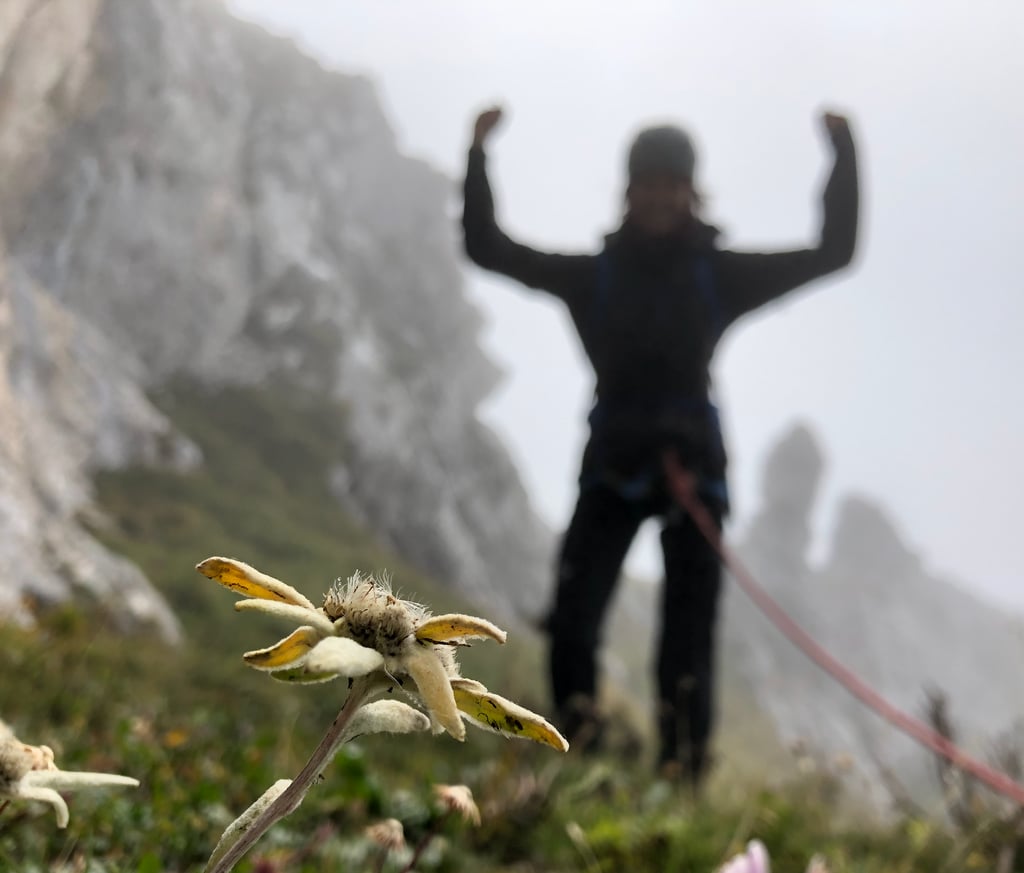
Going into the mountains is not exactly straightforward. It is time-consuming, expensive, physically demanding, and occasionally dangerous. At times, you may even have to deal with the odd unfriendly mountain guide. For many years, I have wondered why so many of us willingly and even gladly accept these costs. My intuition was always relatively simple: the experience of the mountains—the majestic landscapes, the challenge, and the beauty of the activities themselves—is so powerful that it more than compensates for the sacrifices required.
After encountering Arthur C. Brooks’ work on happiness, this phenomenon became much clearer to me. The happiness generated through mountain activities is not accidental. In fact, alpine experiences appear to encompass many of the elements that sociological and psychological research consistently identifies as fundamental sources of human happiness.
According to Brooks, happiness consists of three elements:
Satisfaction
Enjoyment
Meaning
Satisfaction
Satisfaction is the reward we experience after overcoming struggle. Mountain activities—whether hiking, rock climbing, ski touring, or glacier travel—are filled with struggle.
Getting out of bed before dawn is a struggle. Ascending a steep mountain taxes the cardiovascular system. Technical climbing demands muscular effort and concentration. Even mentally, mountaineers are constantly challenged by uncertainty, exposure, risk, fatigue, and fear.
Our understanding of satisfaction is closely tied to dopamine, one of the brain’s key motivational neurotransmitters. Dopamine is not primarily released when we receive a reward; rather, it is released in anticipation of one. The greater the anticipated reward, the stronger the dopamine response.
From an evolutionary perspective, this mechanism evolved to motivate behaviours that increased our chances of survival and reproduction. Dopamine encouraged our ancestors to seek food, find shelter, explore new territory, and pursue mates—all difficult but potentially rewarding activities.
Mountain adventures tap directly into this system. The anticipation often begins weeks or months before the actual climb. First comes the idea, then the booking of the trip, followed by training, planning, gear preparation, and travel. As the objective draws closer, anticipation intensifies. During the climb itself, every step towards the summit reinforces this sense of progress.
Once the summit is reached, dopamine levels begin to decline, often as quickly as they were built up. This may explain why many mountaineers describe a strange emptiness after achieving a long-awaited goal, and why many already start planning for their next ascent before having arrived back in the valley. Yet it also explains why the emotional impact of an trip can linger for weeks or even months after returning home. The satisfaction was not created by the summit itself; it was generated throughout the entire journey towards it.
Enjoyment
While satisfaction comes from struggle, enjoyment arises from consciously chosen pleasure shared with others in a memorable way.
This distinction is important. Pleasure alone does not necessarily contribute to happiness. Excessive consumption of pleasures, the most clear examples: alcohol, social media, gambling, or other instant gratifications can certainly be pleasurable, yet these behaviours often become destructive when pursued unconsciously and without limits.
Our attraction to pleasure is deeply rooted in human evolution. For most of human history, resources such as calorie-rich food, opportunities for reproduction, safety, and rest were scarce. When these opportunities appeared, it made sense to indulge. A bush full of ripe fruit would soon be empty. Winter would inevitably return. Moments of comfort were temporary and unpredictable.
Today, however, many pleasures are available in virtually unlimited quantities. The result is a world where addictive behaviours have become increasingly common.
Pleasure becomes beneficial when it is consciously chosen, shared with others, and embedded within memmorable experiences.
Mountain activities provide exactly this combination. Standing on a summit after a demanding ascent, skiing through knee-deep powder, sharing stories in a mountain hut, or watching the sun rise above a sea of clouds are intensely pleasurable experiences. Because they are shared and hard-earned, they become memorable.
The struggle itself enhances the enjoyment. Research consistently shows that effort increases the perceived value of an experience. The memories become richer, more vivid, and more enduring. Over the years, I have witnessed people moved to tears by the simple joy of a successful day in the mountains—not because the activity was easy, but because it was difficult and meaningful enough to be remembered.
Meaning
Meaning is perhaps the one aspect of happiness that mountains alone cannot fully provide.
A person may experience enormous amounts of satisfaction and enjoyment through climbing and mountaineering while still feeling unfulfilled. This helps explain why even highly accomplished athletes and explorers can struggle with overall happiness.
Brooks identifies several components of meaning:
Coherence – understanding why life unfolds the way it does.
Purpose – a sense of direction and a reason for being.
Significance – the feeling that one’s existence matters to other people.
Faith – connection to something larger than oneself, whether religious, spiritual, philosophical, or otherwise transcendent.
Mountains can certainly contribute to these dimensions. They can inspire awe, humility, perspective, and reflection. They can create communities and lifelong friendships. Yet meaning ultimately extends beyond the mountains themselves. It is found in relationships, service, family, values, faith, and the broader story we tell ourselves about our lives.
Why the Mountains Call Us
One could take this analysis further and ask why the first great mountaineers were not the people living at the foot of the mountains, but rather those arriving from distant cities. Perhaps the answer lies somewhere within this framework of happiness.
For me, at least, the model makes sense.
When people struggle together towards a challenging objective, they generate satisfaction. When they share the beauty, pleasure, and camaraderie of the mountain environment, they generate enjoyment. Meaning may not be supplied by mountains alone, but the mountains provide at least two of the three essential ingredients of happiness in remarkable abundance.
Perhaps that is why we continue to accept the costs, risks, and discomforts of mountain life. Mountains may not guarantee happiness, but they offer one of the most reliable paths towards it.
Why Mountains make happy
HQ
Außertal 36, A-6157 Obernberg
Contact
jef@berggids.be
+43 699 1835 6877
